Showing posts with label Conservation. Show all posts

Tuesday, February 1, 2022

E.U. Citizens' Initiative to Protect Sharks: Final Count.


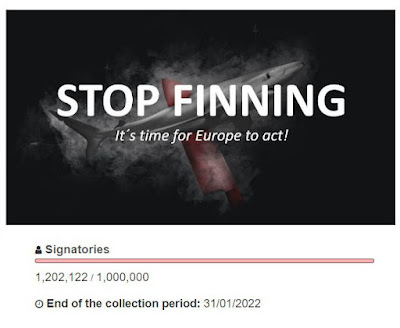
For the past two years, the Stop Finning - EU Organization has been collection signatures of support for the EU Citizens' Initiative to strengthen the EU's shark Finning laws.  The support period has now closed and here are now the final results.

As most of you know, in my last update of the 13th. January I stated that only seven countries had reached their quota target and only 542000 out of the 1,000000 signatures have been collected. 

I am glad to report that in the last two weeks, there has been a huge response and the final results read as follows:

17 countries have reached their quota: Austria, France, Germany, Hungary, Malta, Italy, Netherlands, Belgium, Croatia, Finland, Denmark, Ireland, Greece, Czechia, Luxembourg, Portugal and Spain.
A total of 1,202,122 signatures collected.

 Austria 229.63%

Belgium 119.52% 

Bulgaria 15.78% 

Croatia 117.26% 

Cyprus 20.15% 

Czechia 106.67% 

Denmark 113.83% 

Estonia 34.58% 

Finland 114.05% 

France 592.08%

Germany 685.31%

Greece 112.61% 

Hungary 152.09%

Ireland 112.67% 

Italy 128.94% 

Latvia 16.78% 

Lithuania 11.95% 

Luxembourg 104.97% 

Malta 113.32%

Netherlands 124.33% 

Poland 21.71% 

Portugal 149.17%

Romania 15.55% 

Slovakia 82.05% 

Slovenia 57.51% 

Spain 151.04%

Sweden 64.75% 

I want to thank each and everyone that signed up, for their support and look forward to next step... the presentation of this initiative to the EU. 

My thanks also goes to Nils Kluger and Alexander Hendrik Cornelissen who initiated this campaign.

Thank you.

Thursday, January 13, 2022

Update on the E.U. Citizens' Initiative to Protect Sharks.

In January of 2020, The Stop Finning - EU Organization initiated the EU Citizens' Initiative to strengthen the EU's shark Finning laws. 

Although the removal of fins on board of EU vessels and in EU waters is prohibited and sharks must be landed with their fins naturally attached, the EU is among the biggest exporters of fins and a major transit hub for the global fin trade. EU is a major player in the exploitation of sharks and as inspections at sea are scarce fins are still illegally retained, transhipped, or landed in EU. 

The aim is to end the trade of fins in the EU including the import, export and transit of fins other than if naturally attached to the animal’s body. As finning prevents effective shark conservation measures, the organization is requesting to extend REGULATION (EU) No 605/2013 also to the trade of fins and therefore ask the commission to develop a new regulation, extending “fins naturally attached” to all trading of sharks and rays in the EU. 

To be successful, the EU Citizens' Initiative needs reach the following targets:
i) To collect a total of One Million signatures of support from EU member states.
ii) At least Seven (7) countries must reach a threshold of signatures equal to 1% of its population. 

The seven country target has been reached but so far, only 542000 out of the 1,000000 signatures have been collected and the closing date in the end of this month.
 
Whilst Austria, France, Germany, Hungary, Malta, Portugal and Spain have reached and passed their threshold, these 20 other nations are still below the target.

Belgium 70.76% 
Bulgaria 10.32% 
Croatia 54.64% 
Cyprus 13.16% 
Czechia 49.46% 
Denmark 52.01% 
Estonia 26.79% 
Finland 46.76% 
Greece 52.77% 
Ireland 72.7% 
Italy 87.02% 
Latvia 7.01% 
Lithuania 8% 
Luxembourg 43.92% 
Netherlands 83.6% 
Poland 13.02% 
Romania 11.61% 
Slovakia 50.78% 
Slovenia 47.27% 
Sweden 39.83% 

 We are in the final stretch so please do your best to spread the word and get your friends to support this great cause.

SHARKS NEED YOU NOW!

Thank you.

Saturday, September 11, 2021

The Sharkman meets Greg Nowell


 A single person can make a huge difference when he (or she) decides to dedicate his/her time to achieve a target. This target could have amazing results not only for personal satisfaction but also on a larger scale. This is the story of one such person.

It was back in 2007 that I first met Greg Nowell, when he came to live here in Malta. We had exchanged a few emails before our meeting, and as always I was looking forward to meet another Shark lover. 

Over a few beers, Greg and I talked about our passion and how he would like to contribute towards Shark Conservation. Little did I know that this was the first step towards a brighter future not only for the local shark scene but also internationally.

Since then, Greg and I became close friends and we have worked together on several conservation issues, both locally and also overseas. So, it gives me great pleasure to share with you this Greg Nowell interview.

Monday, August 2, 2021

An amazing woman's incredible lifelong journey into the world of Sharks.


As a very young teen in 1970, I saw Valerie Taylor, her late husband Ron and fellow Australian Rodney Fox for the first time, in the classic documentary "Blue Water, White Death." I was already hooked to the beauty of the underwater world, but it was here that these 3 inspired my love for Sharks and I followed in their footsteps with my lifelong fight to protect these magnificent creatures.


In the new epic documentary Playing With Sharks, Valerie takes us on an amazing journey into her own teen years as a spearfishing champion, her romance with the sea and also with Ron, who made her his underwater model and later his wife. We see the couple embarking on an expedition that changed their lives forever. From spearfishing champions, they soon became world famous for their filming and production of underwater documentaries.


The Taylors travelled around the world filming sharks and educating the general public about the huge misconception that these awesome creatures are mindless killing machines in a time when sharks were labelled as Man-eaters following the release of "Jaws". They became protectors and defenders of our oceans and the creatures that live in it.


Their hard work soon started giving rewards as Australia became the first country in the world to protect the Grey Nurse Shark (Carcharias taurus). This was later followed by conservation measures for: the Potato Cod (Grouper) and Cod hole, The Sea lions, the Coral Sea bird breeding islands, the main breeding grounds of the Southern Right Whales becoming a marine reserve and also protection of the Great White Shark.

This amazing woman's incredible lifelong journey is not over yet as Valerie, now 85, and following Ron's death in 2012, is still involved in conservation issues and still dives to spend time surrounded by and Playing With Sharks.


Thank you Valerie for showing me, and the world, the truth about these magnificent and misunderstood creatures.

Saturday, June 5, 2021

Conservation Measures Give Positive Results.

Over the years that I have been involved in Shark conservation, I always insisted that no matter how small the measures achieved, they do leave positive results. Some might say that protecting a shark species in one area, does nothing as that shark might easily be caught some place else. Whilst that could be true, it also adds to the urgency to protect endangered species in as many places as possible.

Since the discovery of the Megamouth shark (Megachasma pelagios) was made in Hawaii in 1976, I have been keeping records of all known specimens caught or encountered around the world. This is not an easy task as I know that not all catches get to be reported especially those from the Asian continent.... but thank God, things are changing.

Up until I write this, the list of known Megamouths stands at 246. Of these, only 28 sharks survived the encounter and swam happily away. The other 218 ended up either consumed, buried or put on display is some museum. You can find my full list here.

The country with the highest number of Megamouth catches is Taiwan. They are responsible for 152 catches out of which, only 4 were released alive. That is a shocking 61% of all known specimens. It was for this reason that EAST(Environment & Animal Society of Taiwanand Ocean Conservation and Fishery Sustainability Foundation (TOFF last year launched a campaign to put pressure on the government (fishery agency) to protect the Megamouth Shark. They also joined forces with fisheries to promote the catch and release initiative to facilitate the tagging of megamouth sharks for scientific research, with support from the Carrefour Foundation.


This campaign also got the support of other international entities, including Sharkman's World, that wrote to the Taiwanese government backing requests for stringent regulations to protect these endangered sharks.


Finally on November 10th. 2020, the Taiwanese authorities enacted laws that totally protect the Megamouth Shark. The restrictions require that all Megamouths caught in Taiwanese waters are to be returned to the sea, regardless of whether or not they are alive when caught. Fishing operators must report any catches to authorities on returning to port.


This conservation measure had positive results when two days ago, a Hualien-registered vessel caught a shark in their gill nets whilst fishing 2.77 nautical miles off the coast. The boat captain immediately ordered his crew to release the shark as soon as possible. The operation to untangle the shark lasted around 90 minutes and finally the estimated 4m female megamouth shark was set free. A crew member managed to film the release.


After being informed of the news, Carrefour Foundation CEO Marilyn Su pledged to donate a NT $5,000 voucher to the captain of the vessel as a reward for their actions. Deputy Chief Executive Yu-Min Chen donated several cases of drinks to the fishermen to celebrate the release, praising the crew for their conservation efforts.

I hope that these new regulations will remain properly enforced.

My thanks to EAST for the translation of the reports. Great work from all those involved.


Saturday, April 10, 2021

The Sharkman meets Andrej Gajić

Ever since I have been involved with Sharks and Shark Conservation, I have been fortunate to have met and worked alongside quite a few researchers, photographers, conservationists and shark lovers. Most of the "famous" ones belong to my age group or older, but I am also glad to see a younger generation coming up. One such person is a young man from Bosnia & Herzegovina who I call my "Shark BrotherAndrej Gajić. 

I first met Andrej back in 2009 in Brussels, Belgium. We formed part of the Shark Alliance and we were campaigning for better shark conservation regulations at EU level. Since then, Andrej has come a long way in establishing himself as one of today's top Shark researchers, scientist, author, explorer and conservationist. He has even been in inducted into the National Geographic "Explorers Club". It gives me great pleasure to share with you this amazing interview I made with Andrej Gajić. 

Monday, October 28, 2013

14 Shark species now protected in Malta.


Finally, the long awaited updated list of protected species in Malta has been released. The new revised list now has 14 Shark species and 5 species of Rays totally protected. 

The following list forms part of Legal Notice L.N.322 of 2013. Under schedule VI the following species are totally protected:

Sphyrna lewini - Scalloped Hammerhead
Sphyrna mokarran - Great Hammerhead
Sphyrna zygaena - Common Hammerhead
Galeorhinus galeus - Tope Shark
Carcharodon carcharias - Great White Shark
Isurus oxyrinchus -  Shortfin Mako Shark
Lamna nasus - Porbeagle Shark
Carcharias taurus -  Sandtiger Shark
Odontaspis ferox -  Small Tooth Sandtiger Shark
Oxynotus centrina - Angular Rough Shark
Cetorhinus maximus - Basking Shark
Squatina  aculeata  -  Saw-backed Angel Shark
Squatina  oculata  -  Smooth back Angel Shark
Squatina squatina  - Angel Shark


Mobula mobular - Devil Ray
Gymnura altavela - Butterfly Ray
Dipturus batis  - Blue Grey Skate
Leucoraja melitensis - Maltese Brown Ray
Rostroraja alba - White Skate

Also another 12 Shark species are listed under schedule VIII which are species whose taking and exploitation may be subject to management measures. These are;

Alopias vulpinus - Thresher Shark
Carcharhinus brevipinna - Spinner Shark
Carcharhinus limbatus - Blacktip Shark
Carcharhinus plumbeus - Sandbar Shark
Prionace glauca - Blue Shark
Mustelus asterias -  Starry Smooth-hound Shark
Mustelus mustelus - Common Smooth-hound Shark
Mustelus punctulatus - Blackspotted Smooth-hound Shark
Heptranchias perlo - Sharpnose Sevengill Shark
Hexanchus griseus - Bluntnose Sixgill Shark
Centrophorus granulosus - Gulper Shark
Squalus acanthias - Spur dogfish, Spiny dogfish

It has been a long hard road to get up to here, and my thanks goes out to all those that were involved and helped along the way.

Tuesday, June 12, 2012

CITES does not give a damn about endangered sharks.

In a statement released and signed by over 41 scientific marine researchers, CITES are accused of ignoring all  facts and allowing endangered species to be killed. 


Dead sharks at the fish market.

The full letter reads:

'The shark fin trade is not sustainable'

As professional marine scientists who have personally witnessed and documented the dramatic declines of shark populations around the world, we would like to express our concern about the recent misinformation perpetuated in the media, both Asian and international, asserting that the shark fin trade is sustainable.

The reality is that this vast trade is largely unmanaged and unmonitored, and that the shark fin industry in Asia plays little to no role in fisheries management in the countries that are fishing sharks. The slow growth and reproductive rates of sharks makes them extremely susceptible to overexploitation.

Since only a small fraction of shark-fishing nations have any type of shark management plan in place, the assertion that the fin trade is sustainable is not based in fact.

Despite recent claims to the contrary by the Hong Kong-based Sustainable Marine Resources Committee of the Marine Products Association (MPA), there is a wealth of scientific evidence that populations of many shark species are in decline, with the shark fin trade being an important driver. There is a solid scientific consensus that many sharks and indeed other cartilaginous fishes, such as skates and rays, are in severe trouble, and there is emerging evidence that this could be causing wider disruptions in ocean ecosystems.

We the undersigned believe, in the interests of both the global marine environment and the public that depends on healthy ocean ecosystems, that decision makers should be apprised of the full facts of the shark fin issue, most specifically that:

- The shark fin trade, as it currently stands, is NOT sustainable. Peer-reviewed scientific research has shown that the fins of tens of millions of sharks passed through the shark fin trade in 2000. Since then there has been no accurate estimation of the trade volume and corresponding number of sharks killed, making it impossible for the industry to state that the trade is sustainable.

Declines in shark populations have been reported from many locations worldwide, and many areas like the Caribbean, for example, are heavily impacted. Individual populations, such as oceanic whitetip sharks in the Gulf of Mexico and hammerheads in the Mediterranean, have experienced severe declines. These statistics are not mere speculation but are backed up by published analyses in academic journals.

- Shark fins are by far the most valuable part of the shark, which encourages many fisheries to target them or retain them even when they are caught incidentally, rather than releasing them alive. The shark fin trade should therefore be viewed as a major driver of global shark fishing activities, which are often unmanaged and conducted in an unsustainable manner.

- The UN Convention on International Trade in Endangered Species of Wild Flora and Fauna (CITES) does not adequately protect endangered shark species. The International Union for the Conservation of Nature (IUCN) lists 82 species of sharks on its Red List of Threatened Species as Vulnerable, Endangered or Critically Endangered. Yet, CITES regulates trade of just three of these threatened shark species.

Despite meeting the scientific criteria for listing, numerous shark species have been denied CITES protection because politics prevented them from receiving the two-thirds of the votes necessary for a CITES listing. A larger number of species are considered threatened and are therefore prohibited in particular countries or by Regional Fisheries Management Organisations.

CITES tends to lag behind domestic and regional management bodies because of the two-thirds majority requirement and should not therefore be used as the benchmark for whether a species is under threat.

In short, the overwhelming body of scientific data supports the urgent need to focus on adequate conservation and management strategies rather than maintaining unsustainable levels of fishing.

Given that sharks play an important role in maintaining the delicate balance of the world's marine ecosystems, and that many species of sharks are now threatened or near threatened with extinction, there is a rare opportunity to make a significant impact on an issue of global importance by helping to regulate the burgeoning international trade in shark fins.

The letter was undersigned by the following 41 researchers:

Dr Gregor Cailllet; Director Emeritus, Pacific Shark Research Centre; Professor Emeritus, Moss Landing Marine Laboratories, US

Dr Jeffrey C Carrier, PhD; Professor Emeritus of Biology - Albion College; American Elasmobranch Society - Past-President; Adjunct Research Scientist - Mote Marine Laboratory, US

Dr Demian D F Chapman; Assistant Professor, School of Marine and Atmospheric Science, Stony Brook University, US

Dr William Cheung; Assistant Professor, Fisheries Centre, The University of British Columbia, Canada

Dr Philippe Cury; IRD Senior Scientist; Director Centre de Recherche Halieutique Mediterraneenne et Tropicale Sete, France

Dr Toby S Daly-Engel; Assistant Professor of Marine Biology; University of West Florida, US

Dr Giuseppe Notarbartolo di Sciara, PhD; President, Tethys Research Institute, Milano, Italy

Dr Michael L Domeier; President Marine Conservation Science Institute, US

Dr E Esat Atikkan, PhD; Adj Prof, Biology, Adj Prof, Physical Education, Montgomery College, US

Dr Kevin Feldheim, PhD; A Watson Armour III Manager of the Pritzker Laboratory for Molecular Systematics and Evolution; Field Museum of Natural History, USA

Dr Francesco Ferretti, PhD; Hopkins Marine Station, Stanford University, US

Dr Andrew B Gill; Senior Lecturer, Environmental Science and Technology Department, Cranfield University, UK

Dr Eileen D Grogan, PhD; Professor of Biology; Research Associate: Carnegie Museum The Academy of Natural Sciences, US

Dr Samuel H Gruber; Director, Bimini Biological Field Station, South Bimini, Bahamas; Founder IUCN Shark Specialist Group; Founder American Elasmobranch Society; Professor Emeritus University of Miami, US

Dr George J Guillen, PhD; Executive Director and Associate Professor Environmental Science and Biology, Environmental Institute of Houston, University of Houston, US

Dr Richard L Haedrich; Professor emeritus, Memorial University, St John's, Newfoundland & Labrador, Canada

Dr Neil Hammerschlag; Research Assistant Professor, Rosenstiel School of Marine and Atmospheric Science Abess Center for Ecosystem Science and Policy; Director, R J Dunlap Marine Conservation Program, University of Miami, US

Dr Michael Heithaus; Director, School of Environment, Arts and Society, Florida International University, US

Dr Mauricio Hoyos Padilla; Pelagios-Kakunja A C La Paz, BCS, Mexico

Dr Robert Hueter; Director, Center for Shark Research; Associate Vice President for Research, Directorate of Marine Biology and Conservation, Mote Marine Laboratory, Sarasota, Florida, US

Dr Charlie Huveneers; Lecturer and Research Scientist, Flinders University/SARDI - Aquatic Sciences Adelaide, Australia

Dr Salvador Jorgensen; Research scientist; Chief Scientist, White Shark Research Initiative, Monterey Bay Aquarium, US

Dr Stephen M Kajiura; Biological Sciences, Florida Atlantic University, US

Dr Steven Kessel; Post-Doctoral Fellow, Great Lakes Institute for Environmental Research, University of Windsor, Ontario, Canada

Vivian Lam; IUCN Shark Specialist Group, US

Dr Agnes Le Port; Postdoctoral Research Fellow, School of Biological Sciences The University of Auckland, New Zealand

Dr Richard Lund; Research Associate, Carnegie Museum of Natural History, Saint Joseph's University, Philadelphia, Pennsylvania, US

Dr John W Mandelman; Research Scientist, John H Prescott Marine Laboratory, New England Aquarium, Boston, Massachusetts, USA

Dr Mikki McComb-Kobza; Postdoctoral Researcher, Ocean Exploration and Deep-Sea Research, Harbor Branch Oceanographic Institute at Florida Atlantic University, US

Dr John E McCosker; Chair of Aquatic Biology, California Academy of Sciences, US

Dr Henry F Mollet; Research Affiliate MLML, R&D Volunteer Husbandry Division, Monterey Bay Aquarium, US

Dr Elliott A Norse; President, Marine Conservation Institute, 2122 112th Avenue NE, US

Dr Jill A Olin; Post-Doctoral Fellow, Great Lakes Institute for Environmental Research University of Windsor, Ontario, Canada

Dr Daniel Pauly, Professor of Fisheries, Fisheries Centre, The University of British Columbia, Canada

Prof Ellen K Pikitch, PhD; Executive Director, Institute for Ocean Conservation, Science School of Marine and Atmospheric Sciences, Stony Brook University, US

Dr Yvonne Sadovy; Professor, School of Biological Sciences, University of Hong Kong, Hong Kong

Dr Carl Safina; Blue Ocean Institute, US

Dr Bernard Seret; Institut de Recherche pour le Developpement (IRD), Museum national d'Histoire naturelle, Departement Systematique et Evolution, France

Dr John Stevens; Research Fellow, CSIRO Marine & Atmospheric Research, Hobart, Tasmania, Australia

Dr Tracey Sutton; Department of Fisheries Science, Virginia Institute of Marine Science, The College of William & Mary, US

Dr Boris Worm; Associate Professor, Biology Department, Dalhousie University, Canada
_____________________________________

We all know why CITES ignores the facts. It is because of people like Dr. Giam Choo Hoo who sits on it's committee and has conflicts of interests. Dr. Giam is heavily involved in the shark fin trade and has openly admitted that sharks do not need protection.
During a debate held in Singapore, last February, Dr. Giam based his claims on half truths and selective data, not on the general facts.
Shark Savers, on the other hand, provided all the scientific facts to debunk his claim. Please read here.

In my opinion, it is high time that:
1) CITES wakes up and replaces people with personal agendas.
2) Governmental Organisations should base their decisions only on scientific data. 
3) Each Country should decide for itself, which species should be protected based on scientific data and local observations.


Saturday, April 14, 2012

Getting a second chance.


Ever since I have been involved in Sharks and their conservation, I have had the pleasure of meeting some great guys who have devoted their time and energy to do all they can to protect these awesome creatures without thinking about self gratification. Greg Nowell is one of these special people.

Regretfully many people get involved with sharks (or any other creature) for personal gain and to get in the spotlight. Greg is the total opposite. He loves sharks as much as I do and ever since I met him some 5 years ago, he has been in the fore front of shark conservation issues here in Malta and overseas as well.

Greg Nowell is the founder and director of Sharklab Malta, and with Sharkman's World Organization, we are constantly working together on various issues. Greg and his team of Sharklab members are more focused on data collection of shark and rays info collected from local fisheries and of sightings and observations.

Recently, their work took a slightly different path and they are getting their first experience in their own private shark nursery.

Around the end of January, a local fisherman contacted Greg and told him of an unusual find of some strange egg cases at "Qalet Marku" a local rocky coastline. Greg rushed to the spot to find a total of 43 shark egg cases. On inspecting them, Greg found that most of these cases were either empty or badly damaged. Only 9 seemed to be still alive and developing.

Greg took these cases home and placed them in a sea water aquarium he immediately set up. Greg identified the egg as those of The Smallerspotted Catsharks (Scyliorhinus canicula).
Smallerspotted Catsharks (Scyliorhinus canicula). 
4 of the cases died over the next few days. Greg then gave 3 of the cases to fellow Sharklab member Pam Mason. Whilst Greg's eggs were in a 20 degrees heated aquarium, Pam kept hers in a cooler non heated 17 degrees. they started observing the egg cases constantly and exchanging notes. Greg's warmer sharks were noticed to be more active.

Two weeks ago, the first of Greg's sharks hatched and the second followed within a couple of days. The warmer water produced more active sharks. A few days later Pam's pups hatched.


The sharks are now actively feeding on Brine shrimp and raw white fish. The idea is that as soon as these little guys are fit enough, they will be released back into the sea and given a second chance.

Yesterday Greg's nursery had more arrivals. A local diving centre owner found a huge mass of tangled nylon rope in the sea, and on close inspection egg cases were visible.
Shark Egg Pouches entangled in ropes

Greg recovered an astonishing 89 egg cases. Out of these, 13 were found to be still alive and were immediately transferred into the aquarium. Also inside the aquarium, Greg has two huge Nursehound Egg pouches too.

13 Catshark egg cases and the 2 larger white Nursehound


More photos, videos and updates can be found here.

Hopefully these sharks will all live to get a second chance, thanks to Greg and his team of dedicated members at Sharklab Malta.

Keep up the great work guys.

Sunday, March 4, 2012

The Tide is Turning

I have always been an optimist in my life. After yesterday's blog, I feel I must also post a positive note.

A lot has happened since I first got involved in the shark finning issue way back in the early 90's. I remember one of our first victories was when we convinced Singapore Airlines to stop serving Shark Fin Soup. Some months later it was the turn of  Thai Airways to oblige. Progress was slow but we were getting to the people.


Things took a huge boost forward when together, the Internet based Shark Group and the Let Sharks Live Network, we declared "2009 the International Year Of The Shark". A total of 68 World wide Organizations, Groups and Clubs joined forces in this project.

The following excellent video produced by Bloom and the Hong Kong Shark Foundation shows exactly how the Tide is Turning. 


Yes the tide is turning and we can all play a major part in it. Say NO to Shark Fin Soup and spread the word.

Saturday, March 3, 2012

How many Sharks?

This new video has hit the net. It shows a street in Hong Kong  covered with shark fins. As soon as I saw it, I knew that I had seen this street before. A quick search revealed that I was right. In 2010, Alex Hofford filmed the same street.That video can be seen here.

Fins drying up on a Hong Kong Street. Photo by Alex Hofford.
I am not trying to minimise the importance or the impact of what Gary Stokes has filmed. In fact, it is important that these issues keep coming to light, and the public made aware of them.

When ever something like this makes its way to the media, the question that comes to mind is; How many sharks were killed? It is simply impossible to answer. Whether it is hundreds, thousands or millions we will never know. How can one calculate the numbers?

I tried to do a little experiment with a photo taken from the video released by the  Pew Environment Group shown below.


This is a single shark fin fishery in Taiwan. Taiwan ranks as the 4th largest Shark fin trader in the World.

Shark Fins drying up on a roof in Taiwan.
In this photo I counted 176 "trays" of shark fins. Some contain around 20 fins, others as much as 50 or more. I will play it safe and say that each contains 20 fins. That means that here we have over 3,520 fins. If the fins are left out to dry for a week and replaced, than the total of fins in a year will be over 183,000

Lets imagine that in all of Taiwan there are only 25 traders. This would give a total of 4,576000 per year. Considering the fact that Taiwan is only the 4th largest, than Indonesia, India and Spain are catching much more, but for the sake of my argument... lets say they are all equal. 18,304,000 shark fins in one year!!

What about all the other fleets? Chinese, Japanese, Korean, Costa Rican, South African....... etc.... What are the global figures? No one will ever know the truth. Part of that is because a lot of these catches are illegal and do not get reported to fisheries authorities. 

Now before I get bombarded, keep in mind that my numbers are just guess work and they are just estimates based on one photo and a little info. There is nothing scientific about my totals. My only aim is to show the vast numbers of sharks that are being killed just for soup. Be it 15, 32, 73 or 100 Million makes not much of a difference when a plate of soup is driving sharks to extinction. 


Sunday, February 26, 2012

They Did It Again.

I cannot let this one pass without commenting on it. People who work hard to protect nature and promote it's conservation should be praised.

Our dear friends at BEQA ADVENTURE DIVERS have done it again. Within a space of just three weeks, they have been presented with another award! This time it's for Tourism Sustainability at the AON Fiji Excellence in Tourism Awards.

Just 20 days ago, B.A.D. were awarded the Best in Green Economic Development at the Kutoa Community Impact Awards 2012

For those that are not aware of it, B.A.D. is not just another Scuba diving centre. They are much more than that. As I had said in an earlier post, these guys have been working hard at conservation since before the company was actually formed.  The company was set up in 2004 and a few months later they established the Shark Reef Marine Reserve. The first objective of the Fiji Shark Project set up in 2003 was thus achieved. 

The funds collected from the daily dives at Shark Reef is donated to two villages thus helping in their education and economy.

Beqa Adventure Divers also carry out scientific research programmes such as Shark Tagging and Reef Habitat Conservation. They have also sponsored the training of local villagers as Fish Wardens and Snorkelling Guides. In 2009 they developed a Shark Awareness Presentation as part of the Fiji Shark Conservation and Awareness Project, B.A.D.s contribution to the International Year of the Shark. In 2011, they started on the Mangroves for Fiji Project and they have already planted over 39 hectares or 390,000 Mangrove trees!! To kick off 2012, Beqa Adventure Divers are already spear-heading the first ever Fiji Shark Count.

B.A.D's Achievement highlights can be seen here.

Congratulations my friends. The planet needs more B.A.D. people like you.


Thursday, February 23, 2012

The Great Fiji Shark Count


During the month of April. those of you that are in, or find your way to, Fiji, are invited to participate in the first ever GREAT FIJI SHARK COUNT. Whether you are a Tourist or a Local, Snorkler or Diver,  you can be part of this nation wide research project and assist in collecting valuable data about Fiji's underwater biodiversity.

The aim of this project is to collect data about Sharks, Rays and Turtles from all over Fiji. This will provide valuable information about the distribution and abundance of these species. The results will also help in designing better ways to protect Sharks. Being the first survey of its kind, this will also be the Baseline for future surveys.

Participating is very easy. Ask any of the Dive Operators or Holiday Resorts to see if they are participating. You can also contact the Organizers directly. Register your participation on their website at The Great Fiji Shark Count. Survey materials and posters are already available on the site for viewing.


The Organizers are:
Fiji Department of Fisheries and Forests
Marine Ecology Consulting
Eshark
Shark Reef Marine Reserve
Save Our Seas Foundation
The Shark Foundation
Shark Savers
Ocean Soaps

So, for those of you still planing a diving holiday, Fiji is one of the best diving destinations in the World. I can guarantee that the dives you make there will rank among the best you ever make. So why not take this opportunity and take a well deserved holiday whilst helping to save our Sharks.

VINAKA VAKA LEVU.

Monday, February 20, 2012

Philippines Senator proposes total Shark protection.

Philippines Sen. Loren Legarda  yesterday called for the passage of a proposed measure prohibiting the catching of sharks, saying the absence of such law could lead to the extinction of the species. Currently there are no laws that protect sharks in the Philippines and fishermen are regularly engaged in the barbaric act of shark finning.

The practice of shark finning involves the removal of the fins, mostly whilst the sharks are still alive, and  the finless shark is thrown back into the sea to die a slow and painful death. The fins are then used for Shark Fin Soup.

“Clearly, the absence of a law forbidding the catching of sharks gives people the courage to continue the practice, which could eventually lead to the extinction of shark species in the country, especially that they reproduce slowly,” Legarda said. “Sharks, as predators of the sea, play a vital role in regulating the ecological balance, particularly the health of important commercial fish species, population balance, and protection of coral reefs. Being a country with about two-thirds of the known marine species of the Pacific living in its coastal waters, the Philippines plays a crucial role in protecting marine species,”

The Senator also stated the facts that millions of sharks are killed every year and that some shark populations have declined by as much as 90 percent.

Legarda said this concern could be addressed with the enactment into law of Senate Bill 2616, which seeks to banning the catching, sale, purchase, possession, transportation, importation and export of all sharks and rays or any parts of these animals. The bill also proposes to declare unlawful the wounding or killing of sharks and rays, unless there is threat to human life or safety.Shark fin soup and the selling of shark’s fin will also be prohibited to eliminate the demand that results in the massive killing of sharks.

Sunday, July 27, 2008

The Mediterranean: the most dangerous place for sharks

The Mediterranean: the most dangerous place for sharks
by Sonja Fordham
July 21, 2008

Welcome to Discovery Channel's Shark Week Conservation Blog! I'm Sonja Fordham, director of the Shark Conservation Program for Ocean Conservancy (www.oceanconservancy.org), and for the next two weeks, I'll be posting updates and information on shark conservation and related science. I hope you'll join in by posting your questions and opinions on shark conservation.

I thought it was fitting to start this blog series during my visit to the island of Malta in the Mediterranean Sea. The Mediterranean has recently been dubbed "the most dangerous place in the world ... if you're a shark." Hope lies in encouraging Malta, already a leader in regional shark conservation, to seize opportunities to promote greater protection for the region's sharks.
Quick Stats:
Last year, the IUCN (International Union for Conservation of Nature) reported that 42 percent of the sharks and rays in the Mediterranean are threatened with extinction (www.iucn.org). This percentage is higher than those for all other regions assessed around the world.

Last month, the Lenfest Ocean Program (www.lenfestocean.org) released scientists’ findings that several Mediterranean sharks (makos, hammerheads, porbeagles, threshers and blue sharks) have declined by 97 to 99 percent. There are no catch limits in the Mediterranean for these commercially valuable sharks.

In fact, Malta is the only EU country on the Mediterranean to provide any protection for Mediterranean sharks (great white and basking sharks), thanks in large part to efforts of the “Sharkman of Malta” (www.sharkmans-world.com).

The situation for Mediterranean sharks is clearly awful, but there has never been greater opportunity for change. Mediterranean countries, particularly members of the European Union, have tools to improve the situation. For starters, the EU is now developing a Plan of Action for Sharks that can set the stage for widespread improvements in EU shark policies. There are also a variety of regional agreements that can spark conservation actions for sharks, if prompted by countries like Malta.

Check out www.sharkalliance.org to learn more about how you can help save Mediterranean sharks, and tune in again over the next two weeks for news on shark conservation in other regions of the world.